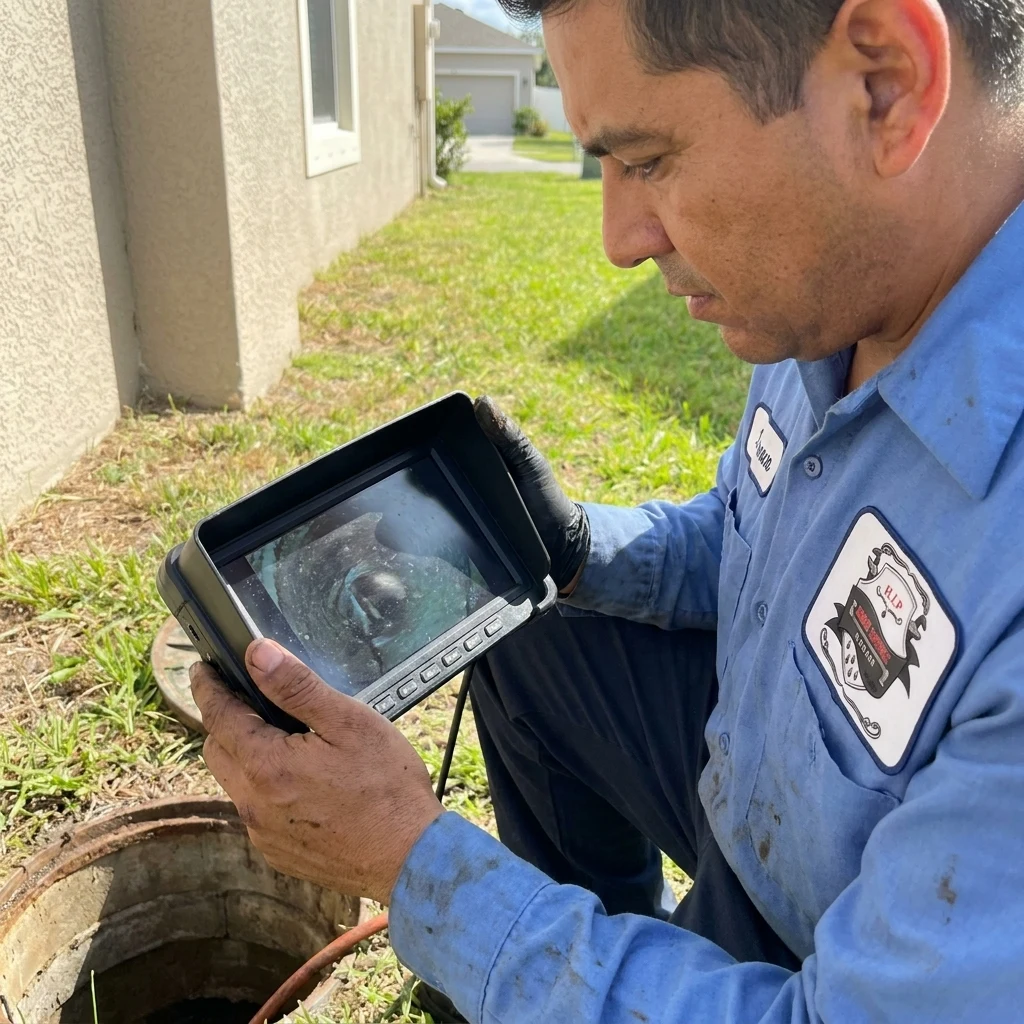
A sewer camera inspection ends with a recording. Then someone says the word belly, or offset, or root intrusion, and the number on the estimate changes. This is a guide to watching the video yourself.
What You Are Actually Seeing
The screen shows a circle of pipe wall lit by the camera head, with the cable's length counter running. White or gray smooth walls usually mean plastic. Rough, scaly or orange-brown walls suggest cast iron. Most Riverview homes are plastic: about 70.7% of units date from 2000 on. Homes built before roughly 1980 may have cast iron, and clay or Orangeburg show up only in the oldest lines. Orangeburg, a fiber pipe made until the mid-1970s, is brittle and about 50 years old under ideal conditions, so if a camera finds it, it is on an old street and it is a repair question, not a cleaning one.
Defects, What They Look Like and Who Fixes Them
| On screen | What it is | A jetter helps? | Next step |
|---|---|---|---|
| Thick, soft coating along the bottom or walls | Grease and sludge | Yes | Jet the line, then habits |
| Hard, rough crust | Scale or mineral buildup | Usually, with the right nozzle | Jet; watch pipe condition first |
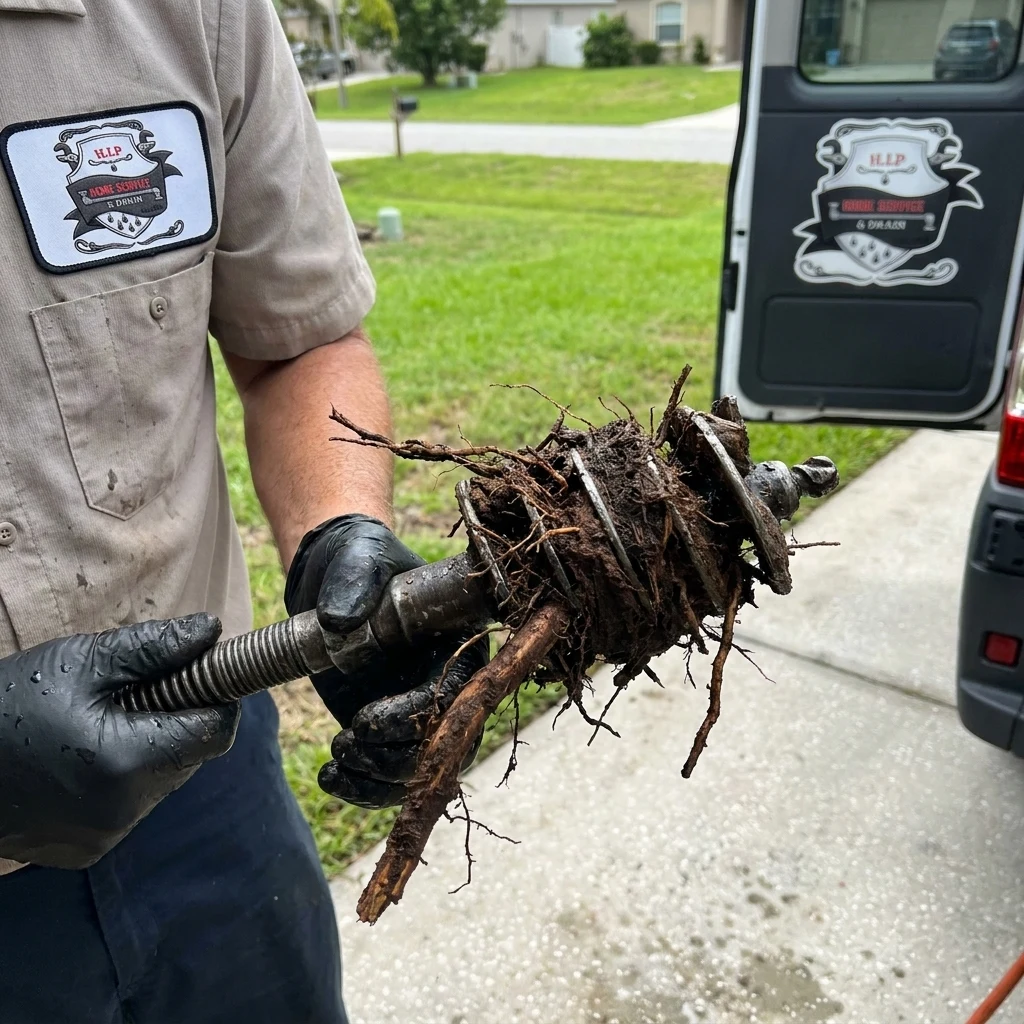
| Thread-like or ropey fibers at a joint | Root intrusion | Cutting then jetting | Clear, and plan regular cleaning |
| Standing water in a dip, with settled solids | A belly, a sag in the pipe | Clears solids, not the sag | Repair contractor if it keeps holding water |
| A step or gap where two pipes meet | An offset or separated joint | Can clear, cannot fix | Repair contractor |
| A dark line along the wall, or a split | A crack or break | Be careful; pressure may worsen it | Repair contractor |
| Pipe is gone, dirt visible, or camera can not pass | A collapse | No | Repair contractor |
| Water trickling in at a joint | Infiltration | Cleaning does not seal it | Repair, if serious |
Roots, Grease and Scale: What a Jetter Can Clear
Roots do not drill through sound pipe, they find a joint or crack and thicken inside it. UF/IFAS notes that roots usually do not penetrate well designed and installed utilities that do not leak, so a root mass on screen is itself a clue that a joint is leaking. Root removal and line clearing cuts the mass and flushes the line; it does not close the entry point, so regrowth is a matter of time. Sewer line hydro jetting also scours grease and silt. A main line with moderate roots is $400 to $750.
Bellies, Offsets and Cracks: What It Cannot
A collapsed pipe, a heavily bellied run and separated joints go to a repair contractor, not a jetter. Fragile pipe is the reason a camera pass comes first, because corroded, cracked or aged pipe can be made worse by pressure. One manufacturer's guidance, for example, caps pressure at the tool at 1,400 psi for plastic gravity pipe. Cast iron can look fine on the outside with the inside nearly gone. We do not publish a single standard pressure because there is not one; it depends on what the video shows.
What a Good Report Adds to the Video
Footage alone is hard to compare from one visit to the next. A useful report names the pipe material and diameter when they can be seen, lists each defect with its distance from the entry point, and says what was cleaned and what was left alone. Keep it with your closing papers or your service file. If you sell the house, or call a repair contractor, that note saves them a second camera run.
How to Ask for a Useful Recording
- Ask that the video start at the cleanout or entry point, with the cable counter visible.
- Ask the technician to say, or note, the distance to each defect.
- Ask whether defects are coded on a severity scale. Many inspectors use the PACP system for that.
- Ask for a second pass after cleaning, if jetting is done the same visit.
- Ask what the technician would not clean, and why.
A stand-alone sewer camera inspection is $150 to $300, often credited toward the work the same visit. For longer-established lots, such as the pre-2000 Boyette Springs plats in Boyette, where 50.9% of lots were platted before 2000, the video is where the roots and scale show up. Our guide to choosing a hydro jetting company lists more questions worth asking.
Last, remember that a camera recording is a snapshot of one day. Roots grow, grease coats and a belly can deepen, so a clean video today does not promise a clean one in three years. That is the reason to keep the footage: next time, you can lay the two side by side and see what changed, rather than guessing from a verbal description.
Have a recording you can not make sense of?
Send the video or describe what you see at 813-733-7188. We will tell you plainly what it looks like, what a jet would and would not change, and when the honest answer is a plumber.
CALL 813-733-7188Camera Footage Questions
It shows what is visible along the stretch it travels: roots, grease, scale, offsets, cracks, standing water. It cannot show what is behind the wall of the pipe, and it stops where the line is blocked or collapsed. A clear video is useful evidence, not a guarantee.
A belly is a low spot where water and solids sit. The picture shows a pool of water in the bottom of the pipe that does not drain away, often with settled debris. Cleaning removes the solids but not the dip, so it can come back.
Sometimes, with great care and lower pressure, but a camera has to decide. Cracked, corroded or aged pipe can be damaged further by the wrong setting. If the video shows serious damage, we say so and recommend a repair contractor.
It is a standard way for inspectors to code sewer defects by type and severity, so two people reading the same video describe it the same way. Not every contractor uses it, and it is worth asking if they do.