Progress Village Hydro Jetting, Old Core and New Build
Progress Village was platted in 1958 to house families displaced by urban renewal and interstate construction, and its nonprofit won a national service award in 1960. The streets around Progress Boulevard still carry that history, but the census place around them is mostly newer: the median year built is 2011, and 52 percent of the homes went up in the 2010s.
That makes two jobs in one community. The original village has about 430 homes from the 1960s plus a few earlier, where a camera belongs ahead of the jetter. The newer sections have 1,484 attached single-family units and 657 homes in buildings of three or more, where shared lines matter. Gibsonton to the south and Riverview to the east share the I-75 corridor.
Progress Village Drainage Flooding vs. a True Clog
The neighborhood has chronic street flooding. The county's regional drainage project puts two 54-inch pipes where a 42-inch pipe crossing runs now, and the county says it will benefit up to 1,000 homeowners; its project page has the current status. When stormwater and groundwater push into a sewer line, drains back up only in heavy rain, then run fine the next day.
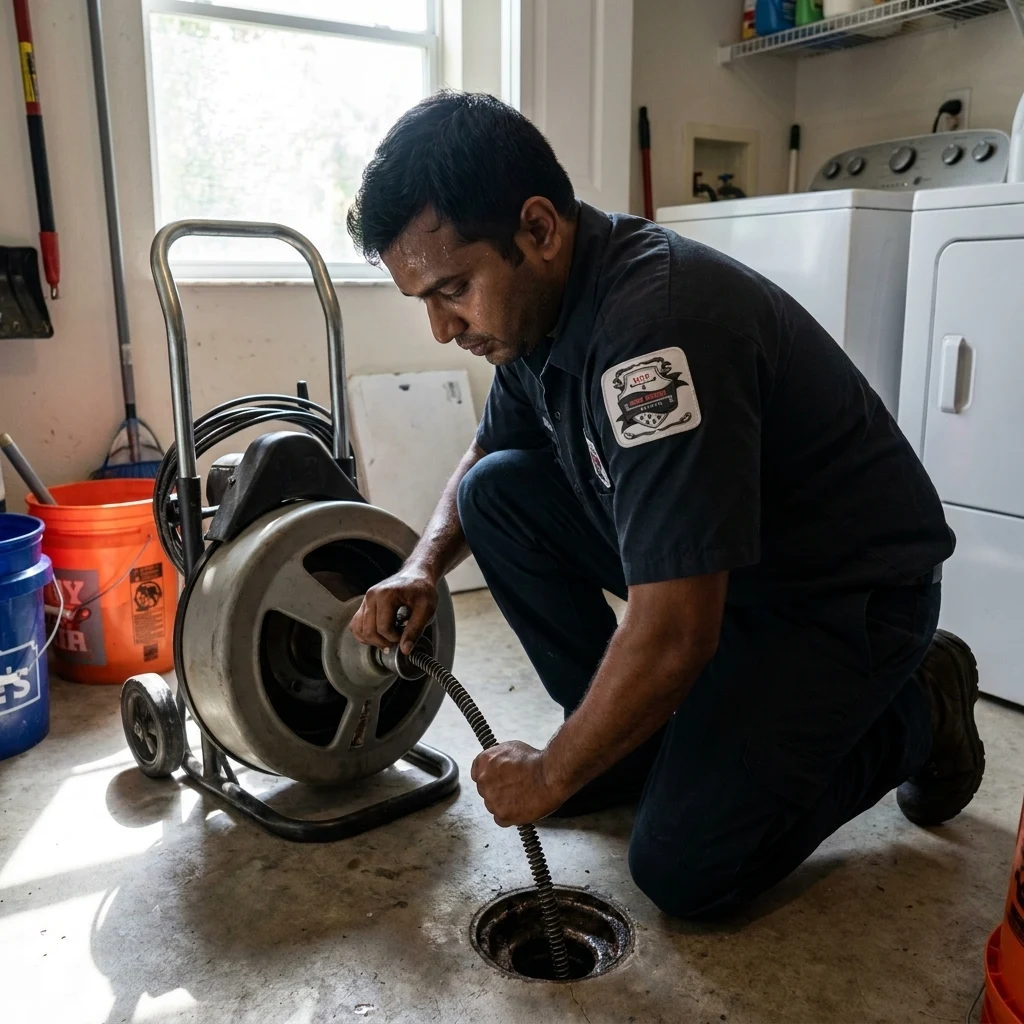
A true clog stays slow in dry weather. That difference decides whether hydro jetting will help. We ask when the drain backs up, look at the cleanout, and use the camera to check joints for infiltration. If a sewer is surcharging in a storm, the answer is not on our truck, and our post on wet-season backups explains why.

Services for Old Blocks and Newer Attached Homes
We start by asking when the drain backs up, because the answer decides the method.
- Hydro Jetting Services — Helps when a drain is slow even in dry weather; it cannot fix a sewer that fills during a storm.
- Sewer Line Hydro Jetting — Used on shared building lines in attached units, with notes on which fixtures were affected.
- Kitchen Line Grease Jetting — Clears the kitchen branch in rentals where repeat grease clogs trigger several service calls.
- Root Removal & Line Clearing — Applies to the 1960s blocks, though the camera comes first on pipe that old.
- Drain Cleaning & Snaking — Quick cable work for a tub or toilet that stopped in dry weather and has no storm link.
- Sewer Camera Inspection — Looks for infiltration at joints and silt left by floodwater, with footage you can show a landlord.
Shared Walls, Renters and the Original Sewer Design
About 35 percent of households here rent and a third of the units are attached, so a stoppage often involves a landlord, a manager or a neighbor. When two units share a drain we find the common line and write down which fixtures are affected, which is usually the quickest way to settle who authorizes and who pays.
A 2024 University of South Florida planning report describes the original design as ten lift stations feeding a plant of up to 1.5 million gallons a day. Who runs the system today is not something we can state, and we do not guess. We clear the pipes in and leading out of the house, and a street-wide backup goes to Hillsborough County Water Resources at (813) 307-1000. The cost guide lists typical prices.
Progress Village: The 1958 Village, Its Parks and Newer Streets
Progress Village was platted in 1958 for families displaced by urban renewal, and the census place now holds far more recent housing than the original village.
- Original village on Progress Boulevard — The planned 1958 village around Progress Boulevard and the Ash, Allamanda, Bahia, Croton, Dahlia and Endive Avenues, with 433 homes built in the 1960s across the census place.
- Simmons Bowers Park area — Community park that hosted the village's 65th anniversary picnic.
- Emanuel P. Johnson Recreation Center area — The center on South 78th Street shares a site with the Larry Sanders Sports Complex, a 120-acre facility.
- South edge near Lamb Elementary — Area around Jack Lamb Elementary and Progress Village Middle Magnet School of the Arts, just south of the county's planned drainage pond.
- Archie Creek corridor — Drainage corridor about five blocks south of Progress Boulevard that discharges toward Tampa Bay.
- Newer-build parts of the census place — 3,770 homes were built from 2000 to 2019 and 1,484 are attached, though subdivision names are undocumented.
Progress Village Landmarks: Progress Boulevard, I-75 and the Archie Creek Corridor
The county's drainage project and the village's parks both use street names, so these are the landmarks residents and the county refer to.
- I-75 — Forms the eastern edge of the census place, separating Progress Village from the newer Riverview side.
- County Road 573 — Marks the western edge of the census place, according to Wikipedia, opposite the I-75 side.
- Progress Boulevard — The village's main street, where the county replaced drainage inlets and outfalls south of it.
- Ash Avenue and South 83rd Street — Streets where the county's new storm drain runs as part of the regional drainage project.
- Archie Creek — Creek that carries the area's storm drainage to Tampa Bay.
- Emanuel P. Johnson Recreation Center — County center at 5855 S. 78th St., site of the 2024 public meeting on the drainage project.
- Simmons Bowers Park — Park that hosted the village's 65th anniversary picnic, with a larger green space across the street.
- Jack Lamb Elementary and the Magnet School of the Arts — Schools on the southern edge, near the planned drainage pond.
Progress Village Flooding, Housing Age and Rental Figures
Census and county numbers for the 33619 census place, which is both an old planned village and a belt of 2000s construction.
- Progress Village has a median build year of 2011, and 2,423 of its 4,643 homes, 52.2 percent, date from the 2010s. More than half the housing is modern plastic pipe, so repeat clogs are mostly grease, wipes and bathroom debris, while the old core is a separate case.
- The census place has 433 homes built in the 1960s and 68 built in 1939 or earlier. Lines laid in the 1960s can be clay or fiber conduit, so a camera pass comes before any jetting on an older house.
- Progress Village has 1,484 attached single-family homes, 32.0 percent of units, and 657 units in buildings of three or more. Shared building drains mean one blockage can back up several units, so who is responsible for the shared line matters.
- About 35.2 percent of Progress Village households rent, 1,533 of 4,356. Landlords and property managers book most repeat clearing, so written pricing and photos of the findings are part of the job.
- The county's estimated $15.7 million drainage project puts two 54-inch pipes where a 42-inch pipe crossing runs now and is expected to benefit up to 1,000 homeowners. When storm drains run slow, water stands longer around yards, and a drain that backs up only in heavy rain may not be a plain clog, so a camera pass earns its keep.
- The village's original plan called for ten lift stations feeding a treatment plant of up to 1.5 million gallons a day. A pumped collection system works hard on grease and wipes, but that design dates from the 1950s, and a house call clears the building drain either way.
Water coming up only in heavy rain?
Call 813-733-7188 and tell us whether it happens only in storms. A drain that backs up only in heavy rain may be stormwater in the sewer, and a street-wide problem goes to Water Resources at (813) 307-1000.
CALL 813-733-7188Flood, Clog or Both? Progress Village Questions
Yes, once the house is dry and safe. Floodwater can leave silt and debris in the line and can reveal cracked joints. A camera pass documents it. If the pipe is damaged, we say so and refer you to a repair contractor; jetting does not fix breaks.
Maybe, after a camera look. Pipe from that era may be clay or a fiber conduit that does not take pressure well. We inspect first, set the pressure to what we see, and use a cable instead if the line is fragile.
Your property manager or landlord, since attached units often share a drain. Call us if you are told to arrange it, and we will take photos of what we find. If it is an emergency, call 813-733-7188 and we will explain which fixtures to stop using.
No. That project is storm drainage: larger pipes under roads, aimed at street flooding. It does not clean a house line. Better drainage may mean less standing water around cleanouts, but a slow drain on a dry day still needs cleaning.
Most drain jobs run $125 to $350. A floor or yard drain that only overflows in storms may not need cleaning at all, so we check whether the line is slow in dry weather first. That avoids charging you for work that will not help.
Around the I-75 Corridor
Riverview
East of I-75, a larger place with a 2006 median home and a different drainage setup.
Gibsonton
South along the same corridor, with wet ground and a county sewer project of its own.
Magnolia Park
A 2013 community north of the Selmon Expressway with townhomes and many renters.
Brandon
Farther north, with shared stacks and rental turnover like the newer attached homes here.