Gibsonton Hydro Jetting and Drain Cleaning in Septic Country
Gibsonton began in 1884 when James Gibson Sr. homesteaded 150 acres at the mouth of the Alafia River, and it later became winter quarters for carnival and circus families that the Showmen's Club and museum still honor. For drains the more relevant fact is newer: the county says most of the Gibsonton area has no centralized sewer and is served by septic systems.
A four-phase vacuum septic-to-sewer project is changing that, with Phase One at about $61 million, running from early 2025 to mid-2027. The Census also counts 1,846 mobile homes out of 6,739 housing units, more than one in four. Septic, small mobile-home drain runs and a conversion in progress make Gibsonton a place where we ask three questions before we touch a pipe.
Gibsonton Septic Systems: What Hydro Jetting Can and Cannot Do
The jetter belongs on the line between the house and the tank. It does not belong in the drainfield, where it can push solids into soil that is meant to filter them. If every fixture drains slowly, the tank is full or the field is waterlogged, and a jetting visit would waste your money. The county itself says saturated ground makes septic systems fail and can send waste back into homes.
Gibsonton sits about ten feet above sea level and 17 percent of the CDP is water, so the ground stays wet. When we camera the line to the tank, we look for roots, grease and an offset joint at the tank inlet. Pumping the tank is a job for a licensed septic contractor, and we tell you when that is the right call.
Services for Septic Lines and Small Drain Runs
We clean the pipe; we never touch the drainfield and we do not pump tanks.
- Hydro Jetting Services — Matched to the pipe: a small nozzle for mobile-home runs and heavier settings only for sound pipe.
- Sewer Line Hydro Jetting — On septic homes this means the line between the house and the tank, and nothing beyond the tank inlet.
- Kitchen Line Grease Jetting — Grease entering a tank is a double problem, so clearing the kitchen branch protects the whole system.
- Root Removal & Line Clearing — Applies to lots with 1960s-to-1980s plumbing where a tree has had decades to reach the line.
- Drain Cleaning & Snaking — A cable often does the whole job in a manufactured home with short runs and no cleanout.
- Sewer Camera Inspection — Runs to the tank inlet to check for roots, grease and offsets before and after the vacuum conversion.
Mobile Homes, Two Pipe Generations and the Vacuum Sewer
About 1,900 housing units here date from 1960 to 1989 and about as many from 2000 to 2009, so one block can have decades-old lines and the next builder-era PVC. In mobile homes the drain runs are short and slim, and a cleanout may not exist, so we choose a smaller nozzle at lower pressure and say up front when access is the limit. Plain cable work often does the job there.
The county's vacuum system takes wastewater by gravity from the house line to a valve pit at the property, then onto a closed vacuum main with no manholes or lift stations. Our work stays on the house side of that arrangement. Our post on septic and conversion projects across south Hillsborough has more, and Apollo Beach to the south has its own coastal sewer wrinkles. The cost guide lists typical prices for a house-to-tank line visit.
Gibsonton Neighborhoods: Gibtown, Gardenville and the Bay Lakes Subdivisions
Gibsonton mixes a showmen's winter-quarters core and older farm roads with subdivisions from the 2000s, and the county says most of the area has no central sewer.
- Gibtown — The showmen's winter-quarters core around US-41 and the mouth of the Alafia River; the ACS shows 1,185 homes built before 1980 across the whole Gibsonton CDP.
- Gardenville — Historic community that appears on a 1936 state road map, home to the Gardenville Recreation Center at 6219 Symmes Rd.
- Tanglewood Preserve — Newer subdivision whose listings sampled show builds in 2010, 2011 and 2013, so house lines are around fifteen years old.
- Carriage Pointe — Phase 1 listings sampled show homes built in 2005 and 2006, which puts those lines at roughly twenty years in the ground.
- South Bay Lakes — Subdivision where a Unit 1 listing shows a 2005 build, one of the mid-2000s pockets in the area.
- East Bay Lakes — Subdivision where a sampled home on Cypress Harbor Drive was built in 2003, among the older of the 2000s developments.
- Florida Garden Lands — Established no-HOA neighborhood according to a realty source; no build year was found, so each address is checked individually.
- Dug Creek and Copper Creek — Townhome communities listed by a realty site; their ages are undocumented, and townhomes share building lines.
US-41, Gibsonton Drive and the Septic-to-Sewer Project Boundaries
The county drew its Gibsonton sewer project around specific roads and creeks, which makes them useful landmarks here too.
- US-41 — Cuts through the heart of Gibsonton and is the road most local businesses face.
- I-75 exits 246 and 250 — Big Bend Road and Gibsonton Drive give the east side of the community its interstate access.
- Gibsonton Drive — The northern edge of the county's Phase 1C vacuum-sewer work area.
- Alafia River — Marks the north boundary of the county septic-to-sewer project and the winter-quarters area at its mouth.
- Bullfrog Creek — The southern boundary of the project, running toward Apollo Beach.
- Symmes Road — Carries the Gardenville Recreation Center and the east leg of the Phase 1B force main toward Poinsettia Street.
- Gibsonton Elementary School — Site of the Phase 1A vacuum pump station in the county plan.
- East Bay Drive and Poinsettia Street — The Phase 1B force main route that runs from south of Bullfrog Creek to Symmes Road.
- International Independent Showmen's Museum — A museum that records the community's carnival and circus winter-quarters history.
Gibsonton Septic, Mobile Home and Vacuum Sewer Figures
County and Census numbers for Gibsonton, where the sewer story is as important as the pipe age.
- Gibsonton has 1,846 mobile homes, 27.4 percent of its 6,739 housing units. More than one in four homes has a short, small-diameter drain run and often no cleanout, so nozzle choice and pressure are set for the line.
- Gibsonton has 1,914 homes built from 1960 to 1989 and 1,921 built from 2000 to 2009, with a median build year of 2002. Two pipe generations share the ZIP, with older roots and scale on one block and newer PVC on the next, so a camera run comes first.
- The county states that most of the Gibsonton area has no central sewer, and Phase One of its four-phase conversion costs about $61 million and runs to mid-2027. During conversion a slow drain can be a tank or drain-field problem, a household clog or a new lateral issue, and we only clear the building drain.
- The county's four-phase Gibsonton vacuum sewer has no lift stations or manholes, and wastewater flows by gravity from each house to a valve pit before the vacuum main takes it. Only the building drain upstream of the valve pit is something a jetting visit can reach; the vacuum main is not part of a house call.
- Gibsonton sits at 10 feet of elevation, and water covers 17.10 percent of its 15.44 square miles. Saturated ground in the wet season presses on septic fields and joints, so a drain that slows after heavy rain may be groundwater and not a clog.
- Gibsonton grew 30.4 percent, from 14,234 residents in 2010 to 18,566 in 2020, and 1,563 homes were built from 2010 to 2019. Many house lines are under fifteen years old, so grease, wipes and builder debris cause more clogs than pipe age does.
Is it the tank or the pipe? We can tell you which
Call 813-733-7188 with the symptom and which fixtures are slow. If it points to a full tank or a soggy field, we will say so and point you to a septic contractor before you pay for jetting.
CALL 813-733-7188Septic Tank, Mobile Home and Vacuum Sewer Questions
A pattern helps. One slow fixture suggests a branch clog; every fixture slow suggests the line or the tank; soggy ground over the field suggests the field. A camera down the line to the tank settles the pipe part. We do not diagnose or work on drainfields, and we will say so.
Per the county, wastewater runs by gravity from your house line to a valve pit, then into the vacuum main. Timing for your street is a county matter. A camera pass before the connection records your line's condition, which is useful if a defect surfaces later.
No. Pumping needs a licensed septic contractor. We clear the pipe between the house and the tank, camera it, and tell you if the symptoms point to a full tank so you do not pay for jetting that cannot fix it.
Not at the right setting. We use a smaller nozzle, lower pressure and a slower feed, and we start with a cable if the line is fragile or poorly supported. If the pipe looks cracked or sagging, we stop and say so instead of forcing it.
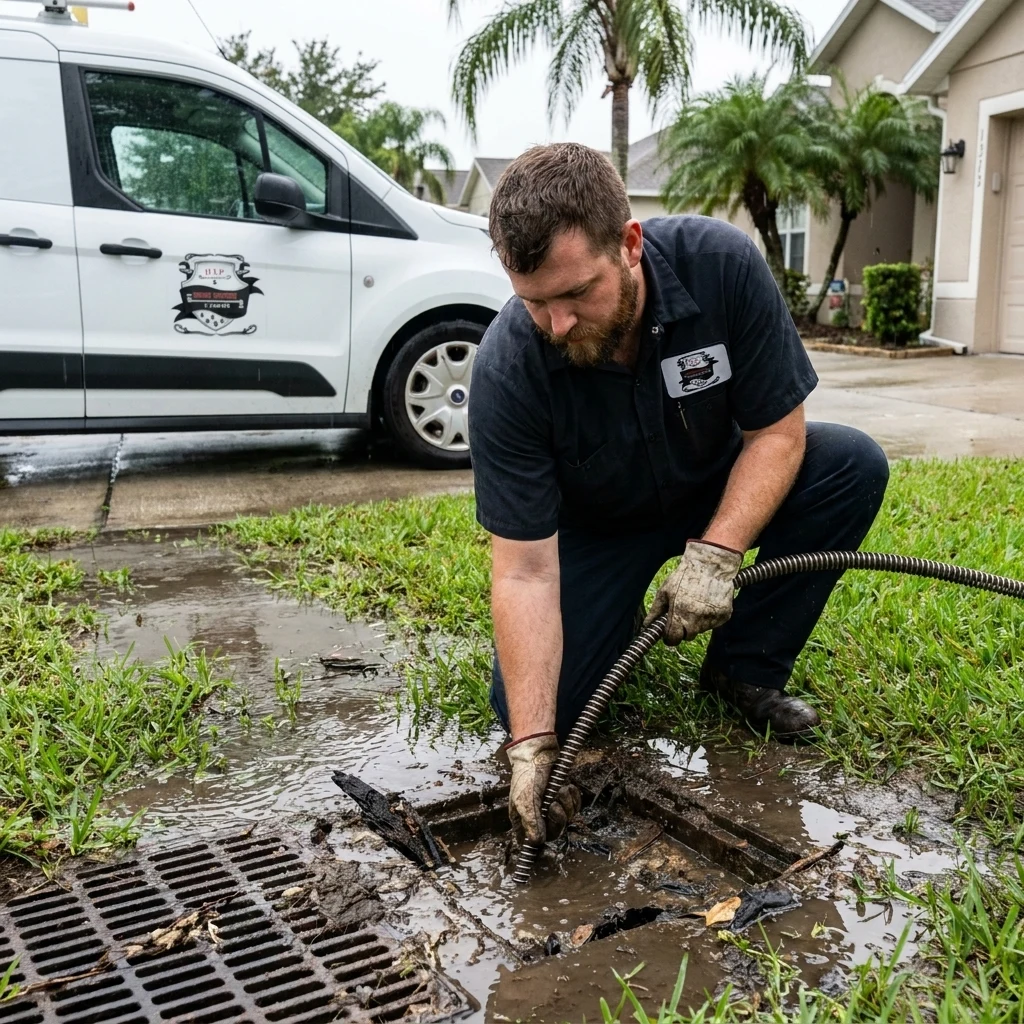
Yes, on residential lots. A yard drain or catch basin gets flushed and checked the same way; it just uses a lighter touch and a smaller nozzle than a main line. Roadside storm drains belong to the county, not to the lot.
Close to the Alafia Mouth
Riverview
North and east, a larger place with similar 2000s construction and a far smaller share of mobile homes.
Apollo Beach
South along US-41, low ground like this, with canals and mostly 2010s construction.
Progress Village
To the north, with its own flooding and mixed housing.
Ruskin
Farther south, facing the same septic-to-sewer shift on a different schedule.