Riverview Root Removal and Line Clearing
UF/IFAS notes that roots usually do not push into properly installed utility lines that hold water. They find the joints and cracks that weep a little. That is the whole story of a root clog: the roots are a symptom of a seam that leaks, and cutting them restores flow without closing the seam.
We cut roots with a rotating or chain-flail head on a drain machine, or with a root-cutting jetting nozzle, then flush with water so the cuttings do not hang up at the next joint. We do not lean on chemicals poured down a toilet: they reach the line in a trickle and do not remove a mass already packed in the pipe. In a city where about 71 percent of the housing units date from 2000 on, grease and wipes cause more trouble than roots, but roots show up where trees are mature or pipe is older.
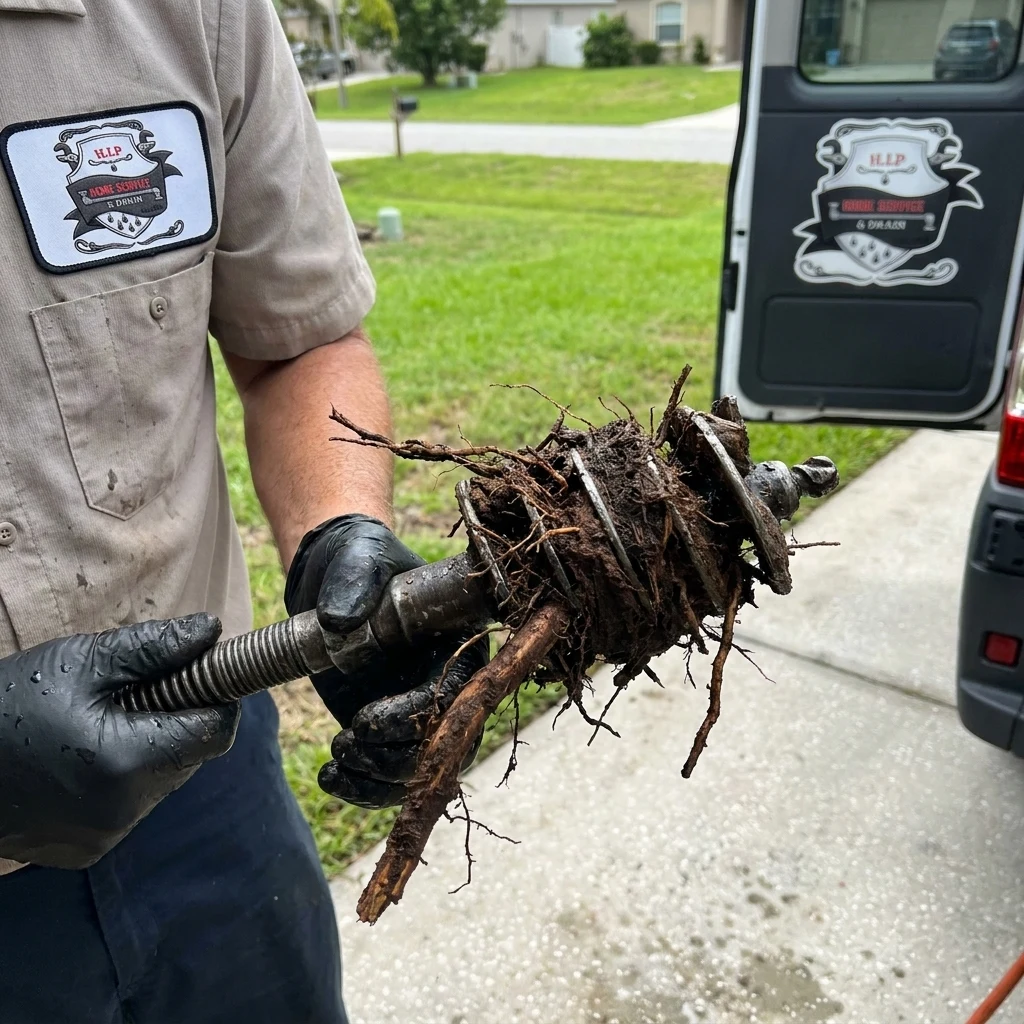
Signs Roots Are in the Line
A grease clog and a root clog feel alike at the sink. These clues separate them:
- The cable or cutter head comes back with stringy, hairy fibers rather than slick paste
- A drain clears after cleaning and slows again within months, always in the same place
- A mature tree stands near the path of the sewer line
- A leaking or newly added irrigation run near the line, which can draw roots toward moisture
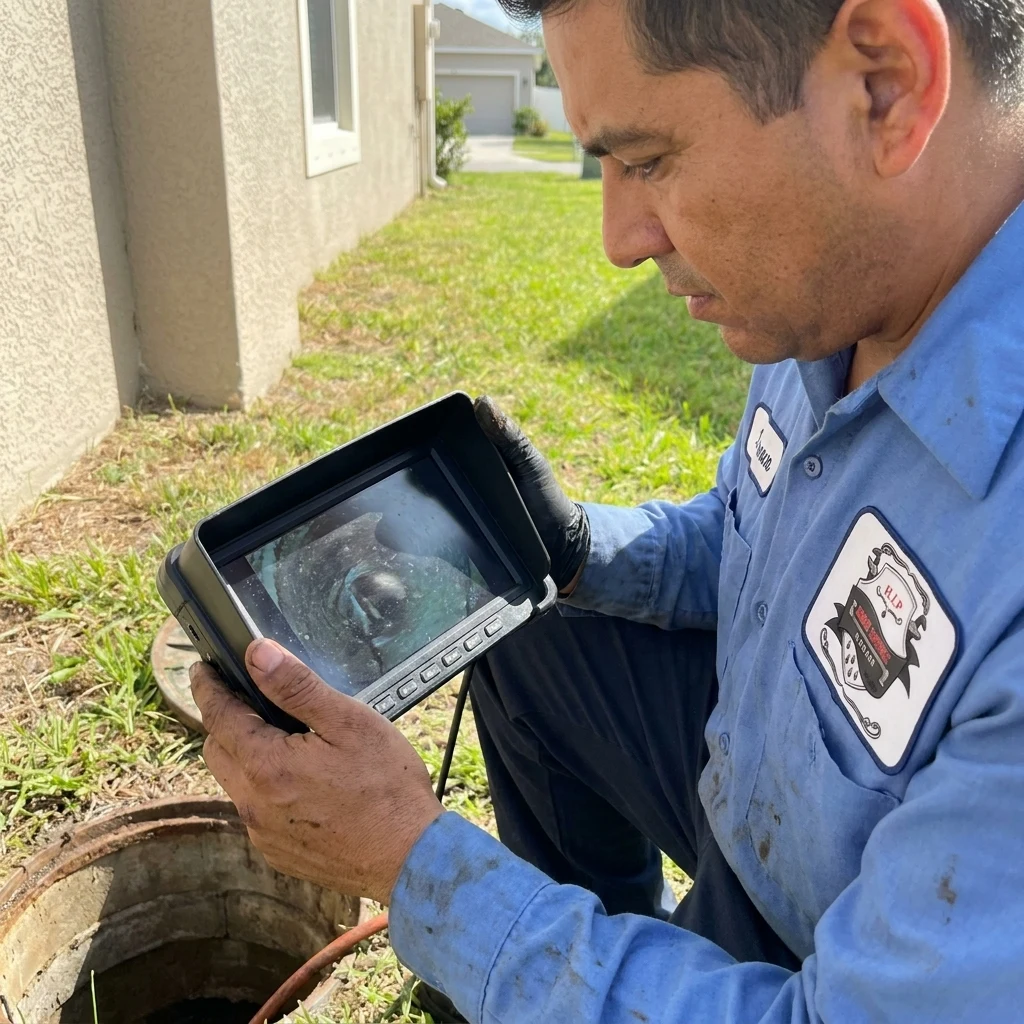
- Camera footage shows fine threads or a mass at a joint
- Slow drains that get worse in the growing season, not the dry one
Which Trees Are Worth Worrying About Near a Riverview Lateral
UF/IFAS describes live oaks as 60 to 80 feet tall with roots that lift pavement, and laurel oak as fast-growing and decay-prone, living roughly 50 to 70 years. It does not say those trees wreck sewers, and neither will we. A big oak near the line is a reason to look with a camera, not a verdict.
Older stretches are likelier to combine mature trees with aging joints: Boyette Springs, with plats from 1986 to 2000, and Summerfield, where more than half the platted lots predate 2000 and some frontage backs onto the golf course. The oldest lines get a camera pass before any cutter goes in. Read how reclaimed and sewer lines differ before anyone digs near a cleanout.
Root Removal Pricing, and When Cutting Only Delays the Repair
Cabling a main line runs $225 to $450. Jetting a main with moderate roots to clear runs $400 to $750, with heavier masses toward the top of that range. The written price comes first, and the free estimate holds for 30 days.
Cutting roots out of a pipe with an offset, a crack or a separated joint buys months, not years, because the roots return to the same opening. If the camera shows one, we say so and recommend a plumber or repair contractor to fix the pipe. We do not dig or replace pipe. The reverse holds too: with no tree anywhere near the line, we look for another cause, and the camera inspection is how we find it.
Riverview Root Removal in the Oldest Lots and Largest Trees
Roots do their damage where trees have had decades to grow beside older lines. These pockets of Riverview and nearby towns have the longest-standing lots.
- Boyette Farms and Boyette Creek — 308 and 566 lots; 13 of the Boyette area’s 35 plats sit on Candler ridge sand, where roots may travel farther for moisture.
- Clubhouse Estates at Summerfield — 176 lots in three units, platted from 1986 to 1994. Lines that old have had decades for roots to find a joint.
- Fairway Estates at Summerfield — 37 lots recorded on December 29, 1986. A small original section, and lines of that age are where a root pass tends to come up.
- Pine Trace at Summerfield — 58 lots in two units, recorded 1987 to 1989. Original lines have had more than 35 years to meet roots at the joints.
- Tropical Acres South — Six plats and 783 lots, the first recorded in 1971. Among the oldest platted sections near Riverview, and older lines are where roots find joints.
- Bell Creek Hammock — Lots run from 0.33 to 3.67 acres beside the 477-acre Bell Creek Nature Preserve. Mature trees nearby put more roots near the line.
- Progress Village — Platted in 1958, and the Census counts 433 homes from the 1960s. Older pipe gets a camera first, then a careful root pass.
- River Hills Country Club, Valrico — About 1,162 homes built from roughly 1988 to 2003. Lines of that age have had time for roots to work into a joint.
Preserves, Roads and Rivers Near Riverview Root Removal Calls
Large preserves and older lot patterns decide where root calls come from.
- Bell Creek Nature Preserve — 477 acres at 10940 McMullen Rd, beside the Bell Creek Hammock lots.
- Triple Creek Nature Preserve — 969 acres of wetland preserve next to the Triple Creek community, which lists Balm Boyette Road as a nearby road.
- Balm-Boyette Scrub Preserve — A county scrub preserve listed among the landmarks of the Boyette area, home to the Boyette Farms and Boyette Creek lots.
- McMullen Road — The road to Bell Creek Nature Preserve at 10940 McMullen Rd and the Bell Creek cluster of subdivisions.
- Boyette Road — The corridor for Boyette Springs, Boyette Farms and Boyette Creek, with the Riverview post office at 10810 Boyette Rd.
- Progress Boulevard — The spine of Progress Village, a community platted in 1958.
- Little Manatee River State Park — Anchors the Sun City Center and Ruskin side of the territory, along the Little Manatee River.
Root Numbers: How Often Roots Return Along Riverview Sewer Lines
Roots are a maintenance problem as much as a clog, and these figures explain the schedule.
- Roots caused 22 percent of reported blockage events in EPA’s 2004 Report to Congress, and another 4 percent were roots and grease together. Roots are the second leading cause after grease, and because they grow back, the fix is a cut plus a plan, not one visit.
- A 2001 review by Randrup, McPherson and Costello says that in smaller pipes, root removal every year or every other year is common. That review also cites studies finding that roots often grow back in greater numbers after cutting, which is why a recurring line gets scheduled maintenance.
- NC State Extension says roots can spread horizontally about two to three times a tree’s height. A tree across the yard can still reach a lateral, so the neighbor’s oak is a valid suspect when a root call comes in.
- UF/IFAS lists live oak at 60 to 80 feet tall with a canopy up to 60 to 120 feet wide, and says its roots may lift and crack sidewalks and driveways. A tree that size has a root system to match, so older lots with live oaks near the house are where root removal comes up.
- The 2001 review also says root removal may cost about one-sixth as much as replacing or renewing a pipe that roots have damaged. Clearing roots on a schedule is the cheaper path than waiting for a collapse, and if a pipe has already failed we say so and refer it to a repair contractor.
Fibers on the cable?
If a cable or plumber has already pulled stringy roots from your line, say so on the phone. It changes the tool we bring and how soon a camera should follow.
CALL 813-733-7188Older Streets and Mature Trees We Work Around
Root calls follow tree cover and joint age, so the older and leafier parts of the area come up first: Riverview, Lithia, Valrico, Brandon, Sun City Center, Summerfield, Boyette, Bell Creek and South Pointe. Newer streets get roots too, usually along irrigation lines or leaking joints, so ask if you are not sure.
Roots, Trees and Pipe Joints
If the seam they entered through is still open, yes. Cutting removes the mass; it does not seal the joint. Timing depends on the tree, the joint and soil moisture. A camera pass afterward shows whether the entry point is minor or a repair-contractor job.
They are slow, reach the pipe unevenly and do nothing for a line already packed with roots, so we cut first. If you want to use a product afterward, read the label for your pipe type and for septic systems, and ask us whether your line really needs one.
Removing a tree stops growth from that tree, but the roots already in the pipe stay until someone cuts them. In an HOA or CDD neighborhood, check your community’s rules before taking down a tree.
The cutter head or cable tells us: roots come back as stringy fibers, grease as slick paste. Roots favor joints in older pipe near trees, grease favors kitchen branches. A camera pass settles it in a couple of minutes of footage.
Rarely by force. UF/IFAS says roots usually do not penetrate well-designed, properly installed utilities that do not leak, so a weeping joint is the invitation. Once inside, roots thicken and trap solids, which is what finally stops the line.